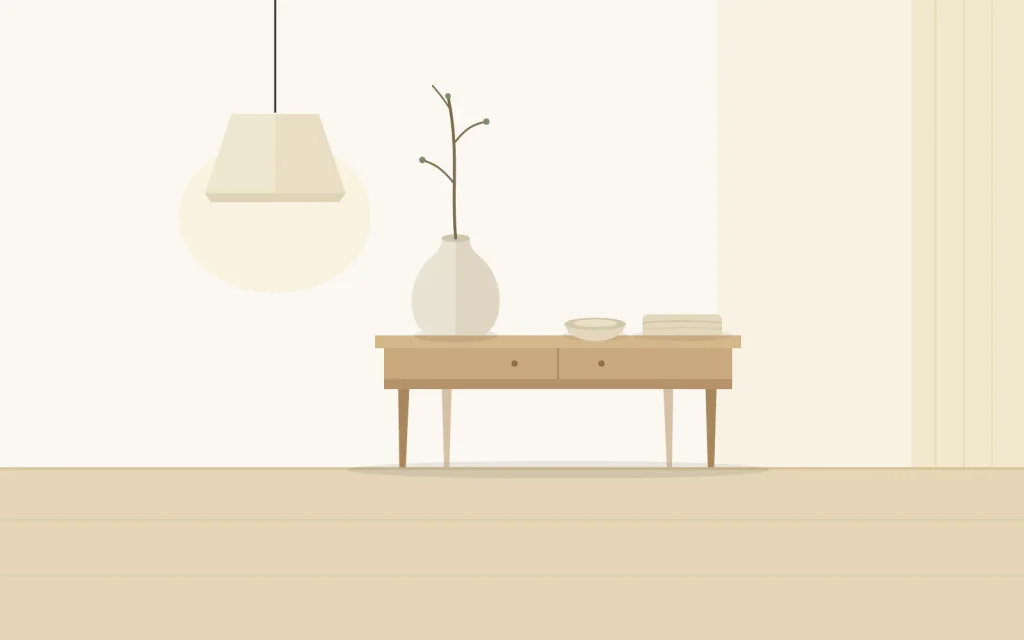
If you have spent any time on Pinterest in the last three years, you have seen the word. Japandi: the slim wooden bench against a chalk-white wall, the single dried branch in a stoneware vase, the linen-upholstered armchair beside a paper lamp, the room that looks somehow both Japanese and Scandinavian and impossibly calm. The aesthetic has been the dominant home-decor language of the international interiors press since 2021, and it has slowly arrived in the Indian conversation through Instagram reels, Studio Apartment YouTube tours, and a small number of design-forward Indian D2C brands.
This guide is for the reader who has been hearing the word and has not, yet, found an honest account of what it actually means, where it came from, and how to build it in a typical Indian apartment without sourcing furniture from Stockholm. The principles, it turns out, are tractable. The palette is forgiving. The starting cost is much lower than the Pinterest aesthetic suggests.
The origin: two aesthetics, one shared vocabulary
Japandi is a portmanteau. Jap from Japanese minimalism — the centuries-old tradition of ma (negative space), the discipline of the tea house, the woodworking restraint of carpenters who built without nails. Andi from Scandinavian functionalism — the Danish-Swedish-Finnish tradition of hygge, of warmth-through-simplicity, of pale woods and white walls and soft textiles. The word itself only entered mainstream design-journalism vocabulary around 2018-2019, but the aesthetic conversation between the two cultures is much older.
Japanese and Scandinavian design have been in dialogue since at least the 1950s. The Danish furniture designer Finn Juhl owned an extensive collection of Japanese ceramics. The Japanese architect Kengo Kuma has cited Scandinavian timber construction as a direct influence. Both traditions arrived at very similar principles independently: honest materials, restrained palettes, functional silhouettes, and an aesthetic preference for things that age well over things that look new.
Japandi, as a contemporary look, is the room where both traditions sit comfortably. The Scandinavian half brings warmth and texture — the linen throw, the pale oak, the wool rug. The Japanese half brings restraint and asymmetry — the low table, the single branch, the empty wall. The conversation between the two is what produces the calm.
The four principles that actually matter
1. Functional minimalism
A Japandi room contains nothing that does not do work. Every object has a function — either practical (the table holds the tea) or aesthetic (the vase holds the eye). There is no purely decorative clutter. There is no shelf full of small objects “to fill the space.” The discipline is to ask, of each object in the room, “what does this do?” and to remove the ones for which the only honest answer is “it fills a gap.”
In practice: walk through your living room tonight with one bin liner. Put into the bin liner every object whose only function is decoration. Take the bin liner to a cupboard. Live with the room for a week. You will not bring most of those objects back.
2. Honest materials in their natural state
Japandi materials are wood, stone, ceramic, linen, paper, wool, and cotton. They are presented in their natural finish — unstained or lightly stained oak, raw linen, unbleached cotton, unglazed or matte-glazed ceramic, brushed brass with patina. The aesthetic rejects materials that imitate other materials: laminate that mimics wood, ceramic with a “marble effect” decal, vinyl flooring with a faux-stone print.
This principle does not require expensive sourcing. A solid sheesham coffee table costs less than a glossy MDF one and reads more correctly. A cotton dhurrie costs less than a polyester rug. The economics, in fact, favour the aesthetic.
3. Asymmetric, off-centre composition
Japandi rooms are visibly asymmetric. The styling is not balanced left and right. The dining chairs are not always six matching pieces — sometimes they are four matching and two contrast benches. The wall above the sofa is not centred art and twin sconces; it is one off-centre object or it is empty. The discipline is to resist the impulse to mirror.
4. The honoured object
One object in each room is allowed to be slightly more present than the others. A particularly fine ceramic vase, an inherited brass lamp, a single sculptural chair. This is the tokonoma principle of the Japanese alcove — the small designated space where one beautiful object is honoured at a time. In a Japandi room the “tokonoma” is implicit rather than walled — a console, a shelf, a corner of the floor. The principle is the same: the room has a focal object, and the focal object earns its place.
Japandi materials are wood, stone, ceramic, linen, paper. They are presented in their natural finish, never imitating something else.
The palette
The Japandi palette is narrower than wabi-sabi, but related. The dominant colours are off-white, oat, soft beige, pale oak, and various warm greys. The accent colours are a small set: muted clay, deep terracotta, dusty black, occasionally a single dark green or dark blue used very sparingly. The aesthetic avoids high-saturation colour and avoids both pure white (too clinical) and pure black (too heavy).
A practical Japandi palette for an Indian apartment:
- Walls: warm white or pale oat (not stark white)
- Floors: existing — Indian wood, terracotta tile, Kota stone all work; cement and marble are acceptable
- Soft furnishings: unbleached cotton, raw linen, oatmeal wool
- Wood: any honey-toned Indian timber (teak, sheesham, mango, neem) — avoid varnished dark
- Ceramics: matte-glazed in off-white, clay, soft black, with restrained hand-painting
- Metal: brushed brass, oxidised copper — no chrome
Why Japandi works in Indian apartments
Indian apartments have two structural advantages for this aesthetic. First, the default wall paint in most rentals is in the correct palette already — Indian “off-white” tends to be warmer than European off-white and reads as oat-toned, which is precisely the Japandi register. Second, traditional Indian timber (teak, sheesham, mango) is in the right tone family — honey to medium brown, not the dark-stained mahogany that sometimes appears in Indian middle-class furniture.
The work, then, is mostly textile and styling — not large furniture replacement. A typical Indian 1BHK can shift to Japandi by changing curtains (linen instead of polyester), cushions (unbleached cotton instead of velvet), one rug (cotton dhurrie instead of synthetic), and adding a small group of correctly chosen ceramic objects. The structural furniture — the sofa, the bed, the dining table — usually does not need to change.
Building a Japandi corner: a step-by-step
Step 1 — Choose the corner
Do not Japandi-fy a whole room in one weekend. Choose a single corner or surface. The most-leveraged Japandi corner in an Indian apartment is one of three: the entryway console, the bedside table, or the corner of the living room beside a window.
Step 2 — Clear it completely
Take everything off the surface. Photograph what was there. Live with the empty surface for forty-eight hours. The eye recalibrates. You begin to see which objects you were tolerating because they were there, not because you wanted them.
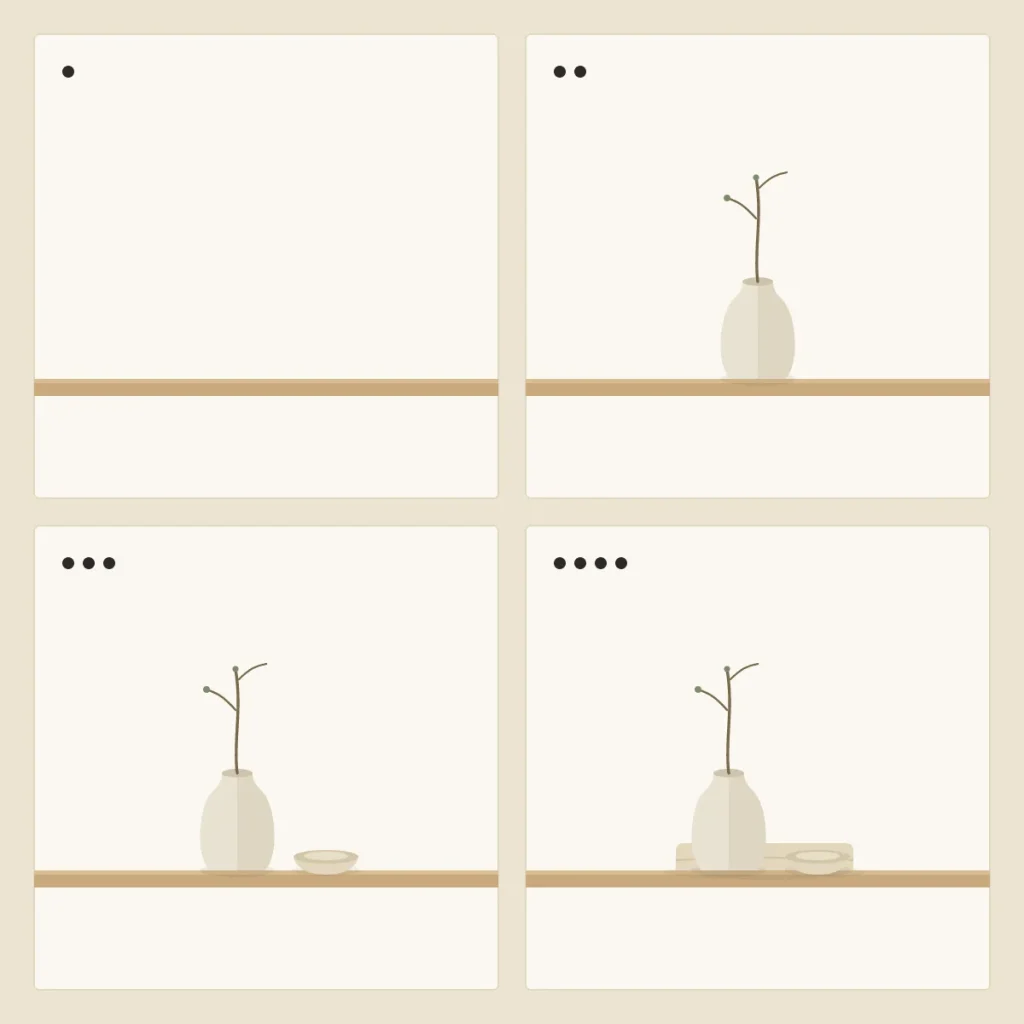
Step 3 — Add the focal object
One vase, one bowl, or one small sculptural ceramic. The Beige Ceramic Loop Vase set with pampas grass” >Beige Ceramic Loop Vase at ₹899 is the most directly Japandi piece in our catalogue — the silhouette is soft and tactile, the colour is exactly in palette, the pampas grass arrives ready-styled. The white textured face vase set” >white textured face vase set at ₹899 reads slightly more sculptural and works well on a low shelf or sideboard.
Step 4 — Add the secondary object
One smaller piece, slightly forward of the focal. A Cat Heart Trinket Dish” >ceramic trinket dish at ₹599 or a single small bowl from the bowl collection” >bowl collection. The piece should be lower in height than the focal object and slightly off to the side, never directly in front.
Step 5 — Add the textile
A folded raw-linen cloth, an unbleached cotton runner, or a small woollen square folded into a rough rectangle. The textile sits under or beside the objects and provides the textural counterpoint to the ceramic. Most Indian homes already own a length of cotton or linen that will work.
Step 6 — Stop
This is the discipline. Three objects and a textile is a complete Japandi vignette. Adding a fourth or a fifth object will not improve it. Add a candle? Add a stack of books? No. Stop. The corner is done.
Japandi by room: small-apartment application
The living room
The living room move is to clear the coffee table to two objects: a single ceramic bowl (catching the keys and the remote) and a small ceramic vase with a stem. Replace any patterned cushions on the sofa with three plain ones — one off-white linen, one oatmeal cotton, one soft clay. Remove all framed art except for the single piece you genuinely love. Replace the polyester rug with a cotton dhurrie. The room shifts in under an hour.
The bedroom
The Japandi bedroom is the easiest conversion. Replace the bedspread with unbleached cotton or linen in cream, oat, or pale grey. Remove framed photographs from the bedside. Add a single hand-painted ceramic dish to each bedside table — holding watches, glasses, the wedding band. The work is mostly subtraction.
The dining area
The dining table needs one centrepiece — a single low ceramic bowl, or the ceramic vase pair” >ceramic vase pair with one tall dried stem in each. The dinnerware: matte-glazed, off-white, with restrained hand-painting. The Woodland Floral Terracotta Rim Dinnerware Set” >Woodland Floral Terracotta Rim Dinnerware Set at ₹1,999 sits comfortably inside the aesthetic — the terracotta rim is a clay reference, the hand-painted floral is asymmetric in execution, the white base is correctly in palette.
The kitchen
Japandi kitchens are visibly composed. The counters carry three or four ceramic storage pieces, the masala jars on a single tray, the cooking oils decanted from their commercial bottles into amber or ceramic. The hand-painted ceramic canister with wooden lid” >ceramic canister with wooden lid at ₹999 and the ten-piece condiment jar set” >ten-piece condiment jar set with tray at ₹599 take the visible kitchen from “Indian middle-class default” to “composed Japandi” for under ₹1,600.
The bathroom
The bathroom move is to decant. Soap into a ceramic dish. Amber-glass soap dispensers and bath salt jars are coming to our catalogue — coming to The Plush Republic later this year — until then, scour your kitchen for unbranded glass jars. The bottle that the supermarket olive oil came in, washed and relabelled, is the canonical Japandi dispenser.
The work-from-home corner
The work corner needs one styled element to feel composed and the rest to be ruthlessly functional. A single ceramic mug for tea, one ceramic dish for paperclips, a small linen pencil cup — total under ₹1,500. The desk lamp should have a paper or linen shade, not a metal one. The chair is allowed to be the existing office chair you already own; you do not need to buy a Hans Wegner reproduction.
The fifteen-piece Japandi starter list for small Indian apartments
If you are starting from a typical Indian rental and want to convert one room to Japandi over a single weekend, this is the shopping list, in priority order. Total under ₹8,000.
- One large ceramic vase — Beige Ceramic Loop Vase” >Beige Ceramic Loop Vase with pampas grass (₹899)
- One ceramic vase pair — Textured Face Vase set” >Textured Face Vase set (₹899)
- Two hand-painted ceramic mugs in matte stoneware (₹399 each = ₹798)
- Two ceramic bowls in coordinated tone (₹449 each = ₹898)
- One ceramic trinket dish” >Cat Heart trinket dish (₹599)
- One ceramic canister with wooden lid” >ceramic canister with wooden lid (₹999)
- One ten-piece condiment jar set” >ten-piece condiment jar set with tray (₹599)
- One raw-linen runner or three small cotton cushion covers (₹600-1,500 from a textile store)
- One bunch of pampas grass or dried wheat (₹200-400 from a florist)
- One small woollen throw in oatmeal or cream (₹1,000-1,500)
The vases, mugs, bowls, trinket dish, canister, and condiment set come to ₹5,192 from our catalogue. Add the textile, dried stems, and the throw from local sources and you are at about ₹7,500. The room is recognisably Japandi.
What people get wrong about Japandi
Three predictable misreadings.
Cold minimalism. Japandi is not Bauhaus and it is not Scandi minimalism by itself. It is warm. The Japanese half brings the warmth — the wood, the paper, the textile, the matte glaze. A Japandi room that feels cold has over-corrected towards the Scandinavian half. Add a wool throw and a hand-painted ceramic and the temperature shifts.
Imported-furniture-required. The Indian conversation often assumes Japandi requires a Stockmann sofa and a teak bench imported from Copenhagen. It does not. The aesthetic is structural — silhouette, palette, materials — and Indian furniture in honey-toned wood, with the right textile and ceramic styling, reads Japandi cleanly.
Over-curating. The Pinterest version of Japandi shows rooms with seven plants, three vases, four ceramic dishes, two paper lamps, and a textile-laden floor. This is the trap. Japandi rooms have few objects, each chosen carefully. If you find yourself adding the fourth ceramic to a console, remove the third.
The shorter answer
If you want a one-paragraph definition: Japandi is a calm, functional interior aesthetic that combines Japanese minimalism (negative space, asymmetric composition, honoured single objects) with Scandinavian functionalism (warm woods, soft textiles, restrained palette). It is built from a small set of honest materials — wood, stone, ceramic, linen, paper — in a narrow warm-neutral palette. It rewards subtraction and punishes clutter. It works exceptionally well in Indian apartments because the default Indian palette and timber are already in its register.
Start with a single corner. One vase, one bowl, one textile. Stop there. Live with the result for a week. The room will tell you what to do next.
Back to journal