The minimalist aesthetic is the most-promised and least-delivered home-decor look on the Indian internet. Every YouTube apartment tour claims it. Every Pinterest board labelled “minimal” carries it. Almost none of the homes shown in either format are actually minimalist. They are merely under-decorated, or expensively styled with so many objects that nothing reads as the focal point.
This guide is for a specific reader: the Indian renter who has just moved into an apartment, cannot put nails in the walls, cannot paint anything, has a small budget, and would like the home to feel composed within a single weekend. The framework: eight specific pieces, each justified, total spend under ₹7,000. No painting. No drilling. No landlord conversation.
What “minimalist aesthetic” actually means in a rental
The serious version of minimalism is a discipline of having very few possessions — under a hundred, in some accounts — and replacing variety with quality. The Pinterest version of minimalism is a discipline of having a great many possessions, all in the same colour, photographed to look as if there are few. The renter’s version is something in between: enough objects to make the home function and feel composed, few enough that each one earns its place, all of them chosen in a narrow palette so the room reads coherent.
The minimalist aesthetic for an Indian rental means: a warm-neutral palette throughout the visible objects; a small number of pieces (eight, in this guide), each carrying a clear function and a clear visual role; no decorative clutter; nothing that requires alteration of the apartment’s structure. The aesthetic is built entirely on freestanding objects and existing surfaces.
The constraint as design discipline
The rental constraint — no drilling, no painting, no permanent changes — is, in fact, an aesthetic advantage. It forces the styling to work freestanding rather than wall-mounted. It removes the entire category of “gallery wall” temptations that ruin most contemporary Indian apartments. It pushes the styling onto existing surfaces — the kitchen counter, the dining sideboard, the bedside table, the coffee table — where it actually gets used daily.
The eight pieces below are chosen specifically with this constraint in mind. Each one is freestanding. Each one fits into existing surfaces. None requires the wall.
The rental constraint forces the styling to work freestanding. This removes the entire category of gallery-wall temptations that ruin most Indian apartments.
The eight-piece starter kit
Piece 1 — The floor vase with pampas grass (₹899)
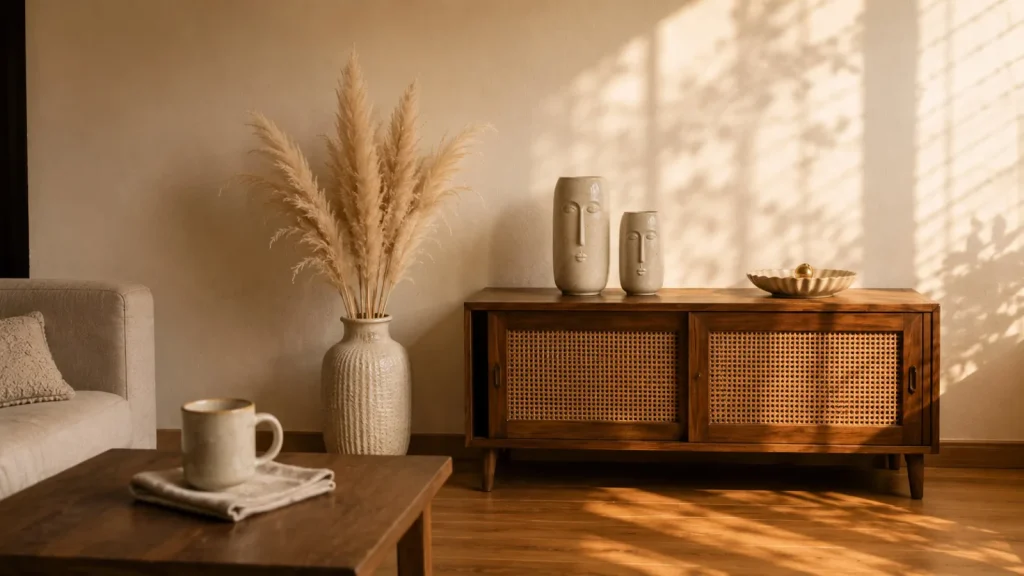
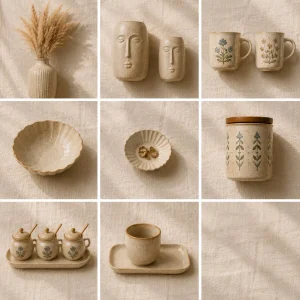
The Beige Ceramic Loop Vase set with pampas grass” >Beige Ceramic Loop Vase set with pampas grass is the single most-leveraged purchase in the entire kit. It does three jobs in one. It fills the awkward floor corner that every Indian rental has — the corner near the window, the corner between the sofa and the wall, the corner at the end of the bookshelf. It introduces an organic element to the room without requiring you to remember to water anything. And it establishes the palette of the entire styling — beige, clay, soft cream — that every subsequent piece will play against.
Placement: against a wall, slightly off the corner, with the pampas grass leaning outward. If you have a corner with a window, place the vase slightly to one side rather than dead-centre under the window. The off-centre placement reads as composed.
Piece 2 — The pair of textured face vases (₹899)
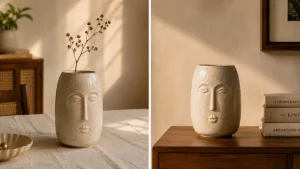
The white textured face vase set of two” >white textured face vase set of two covers two surfaces in one purchase. Place one on a small dining-table centrepiece position. Place the other on a bedroom dresser. Two surfaces styled with a single ₹899 purchase. The textured glaze gives the eye something to land on; the abstract face silhouette adds a sculptural element without being explicit.
The vases do not need flowers — they are designed to read as objects in themselves. If you want to put a single dried stem in each, the styling is enhanced. Empty vases are fine.
Piece 3 — Two coordinated hand-painted ceramic mugs (₹798)
Two mugs from the hand-painted ceramic mug collection” >hand-painted ceramic mug collection at ₹399 each. The picks: the ribbed speckled stoneware in white and sand (matte texture, sits in palette) and the blush pink ribbed stoneware (introduces one warmer accent without breaking the neutral scheme). Pick any two that look coherent together when placed beside each other.
These are the two mugs you and your partner will reach for first every morning. They go on the kitchen counter beside the kettle, not in the upper cabinet. The visibility is the styling.
Piece 4 — A hand-painted ceramic bowl (₹699)
A single bowl from the bowl collection” >bowl collection at the ₹599-699 band — the white heart confetti bowl, the green polka dot pear bowl, or the watermelon red-and-green-rim bowl. Pick the one whose hand-painting most matches your room’s palette.
The bowl lives on the dining table by default. It catches fruit, holds an evening snack, becomes the place you empty your pockets into. When friends come over, it carries a bowl of cashews or chips. Bowls in this size category are the most-used objects in any home; the one good one becomes the one you reach for.
Piece 5 — The ceramic trinket dish (₹599)
The Cat Heart Trinket Dish” >Cat Heart Trinket Dish or the Ceramic Star Trinket Tray” >Ceramic Star Trinket Tray. The piece lives on the entryway console (catches keys), the bedside (catches earrings), or the bathroom counter (catches rings before the shower). Choose whichever surface you most often complain about being cluttered. The dish removes that clutter in one motion.
Piece 6 — The hand-painted ceramic canister with wooden lid (₹999)
The Handcrafted Orange and Grey Stripe Ceramic Canister with Wooden Lid” >Handcrafted Orange and Grey Stripe Ceramic Canister with Wooden Lid. The single biggest kitchen-counter transformation available at this price band. Decant one frequently-used kitchen staple — sugar, salt, or basmati rice — from its plastic packet into the canister, and the visible counter shifts immediately from “Indian middle-class default” to “composed Japandi-minimalist.”
The canister sits beside the gas stove or beside the kettle, whichever is your higher-frequency cooking zone. Visibility matters; do not hide it in a corner.
Piece 7 — The ten-piece condiment jar set with tray (₹599)
The Blue Stripe Condiment Jar Set with Tray” >Blue Stripe Condiment Jar Set with Tray. The trick: do not put all ten jars on the counter. Use only four — for the four spices you reach for most often (probably haldi, jeera, dhania powder, and a chilli). The other six jars go into a kitchen cupboard, ready to swap in when one of the front-four runs out.
The four-jar arrangement on the small tray sits beside the stove. The masalas are now within arm’s reach during cooking instead of buried in a drawer. The visible kitchen has gained four ceramic objects and lost the chaos of plastic packets.
Piece 8 — The hand-painted ceramic mug and tray set (₹599)
The Handcrafted White Daisy Ceramic Cup and Tray Set with Orange Handle” >White Daisy Ceramic Cup and Tray Set with Orange Handle. The eighth piece is the small ritual object. The tray-and-cup arrives ready-styled and lives on the bedside table, the work-from-home desk, or the reading nook side table. It is the cup you drink your last tea of the night from. The styling principle: a single curated piece that announces “this is where I have my last ten quiet minutes of the day.”
The total spend and the order of purchase
The eight pieces from our catalogue come to ₹6,091. Under the ₹7,000 cap with room to spare. If your budget is tighter, the order of purchase from most-impactful to least:
First ₹2,500: The floor vase with pampas grass (₹899), the textured face vase pair (₹899), and the trinket dish (₹599). Three pieces, four surfaces styled (one floor corner, one dining table, one dresser, one entryway).
Next ₹1,600: The ceramic canister (₹999) and the condiment jar set (₹599). Kitchen counter transformed.
Next ₹1,000: The two hand-painted mugs (₹798). Morning ritual upgraded.
Final ₹1,000: The bowl (₹699) and the cup-and-tray set (₹599). Dining table and bedside.
You can stop at any tier. The first tier alone (₹2,500) lifts a typical Indian rental noticeably. The full kit (₹6,091) shifts the entire visible aesthetic.
Placement map for a typical 1BHK
A working placement map for the eight pieces in a one-bedroom-hall-kitchen rental of approximately 600-800 square feet:
Floor corner near the living room window: Floor vase with pampas grass.
Dining table centre: One of the textured face vases.
Bedroom dresser: The other textured face vase.
Kitchen counter beside the kettle: The two hand-painted mugs.
Kitchen counter beside the stove: The ceramic canister and the four-jar condiment tray.
Dining table (off-centre of the vase): The hand-painted ceramic bowl.
Entryway console or shoe-rack top: The ceramic trinket dish.
Bedside table: The cup-and-tray set.
Eight pieces, seven distinct surfaces styled. The remaining surfaces in the apartment — the bathroom shelf, the work-from-home desk, the second bedside table — can be addressed with subsequent purchases later in the year, or with objects you already own that match the established palette.
The layering rules
Once the eight pieces are placed, three small layering moves complete the aesthetic.
Layer one: one folded textile per surface. A folded linen napkin under the dining-table vase. A folded cotton runner across the kitchen counter (rolled at one end). A small woollen square folded into a rectangle on the bedside under the cup-and-tray. The textile costs almost nothing — small remnants from a textile store at ₹100-300 — and adds the textural variation that ceramic alone cannot provide.
Layer two: one organic element per surface, where it makes sense. The pampas grass in the floor vase is given. Add a single dried stem (eucalyptus, wheat, bare branch) to each of the textured face vases. Add a small piece of fruit (a single yellow apple, a lemon) to the dining-table bowl when it is empty. The kitchen canister, condiment jars, and trinket dish stay organic-free.
Layer three: one small book or paper element per surface, where the surface accommodates it. A folded magazine or a single hardback book beside the cup-and-tray on the bedside. A small hand-written grocery list propped against the canister on the kitchen counter. These are the daily-life signals that prevent the styling from reading as a magazine photograph rather than a lived room.
The maintenance rhythm
Once built, the eight-piece kit requires almost no maintenance. The ceramics need to be washed by hand to preserve the hand-painted glazes (read our care guides” >care guides for specifics). The textiles need occasional rotation through the wash. The dried organic elements last twelve to eighteen months before they begin to look genuinely tired.
The aesthetic discipline is to resist adding to the kit. The first impulse, two months in, will be to buy a ninth or tenth piece. Resist. Each addition reduces the spaciousness that makes the eight-piece kit work. If you want to refresh the room, swap one piece for another — but do not stack.
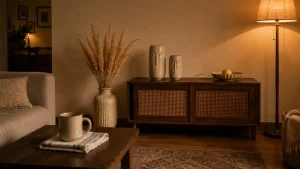
Why this works in Indian rentals specifically
Three structural reasons. First, the eight pieces are all small-footprint — each occupies between three and twelve inches of surface — which suits the smaller surfaces in Indian apartments. A Pinterest “minimalist” home with a 60-inch credenza is irrelevant to a typical Bengaluru flat with a 36-inch sideboard. The pieces below are sized for the smaller surface.
Second, the pieces are all hand-painted ceramics, which makes them robust against the heat, the humidity, and the dust of Indian conditions. Stoneware does not warp in monsoon. Hand-painted glazes survive being washed daily. Wood-and-ceramic combinations age slowly. The materials are matched to the climate.
Third, the pieces all rest on existing surfaces rather than requiring new furniture. The console table you already own. The bedside table that came with the rental. The kitchen counter that is already there. No assembly, no IKEA-trip, no negotiation with the landlord about wall-mounting.
What this kit deliberately leaves out
Three categories of object are deliberately absent. Scented candles, soap dispensers, bath salt jars, and acacia wood trays — coming to The Plush Republic later this year — until these arrive in the catalogue, the kit stays at eight ceramic pieces. Framed art and wall-hung pieces are excluded because the brief is no-drilling. Larger furniture pieces (consoles, bookshelves, low benches) are excluded because the brief is rental-friendly.
These exclusions are not gaps in the aesthetic. They are deliberate boundary lines that let the kit be both buy-able in a single weekend and assembled in a single afternoon.
The shorter answer
Eight pieces. Under ₹7,000 total. Eight surfaces transformed across a typical 1BHK. Order of purchase: vases first, kitchen visibility second, dining and bedside last. No nails, no paint, no landlord. The aesthetic is built entirely on freestanding ceramic against existing surfaces, layered with small textiles and a single organic element per surface.
If you have time for only one purchase this weekend, buy the floor vase with pampas grass. If you have time for two, add the textured face vase pair. If you have time for three, add the trinket dish. Three purchases for under ₹2,400 deliver four styled surfaces. That is the highest leverage in the entire kit.
Browse the home decor collection” >home decor collection or the vase collection” >vase collection for the foundational pieces.
Back to journal