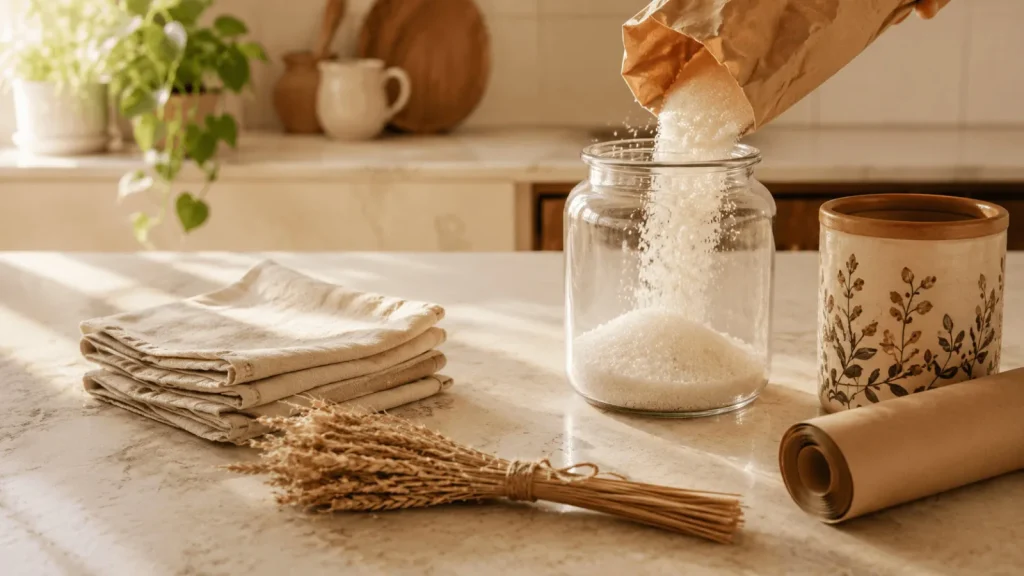
Most DIY aesthetic content on the Indian internet promises miracles that require an angle grinder, a glue gun, and a four-hour Sunday. This guide does not. The twelve projects below are designed for the renter without tools, the working professional with one hour on a Saturday morning, and the resident who has never operated anything more complicated than a kitchen scissors. Each project finishes in under an hour. Each one looks bought, not built. Each one is paired with the small ceramic or styling piece that anchors it.
The principle underneath every project: most “aesthetic” home decor is not skilled craftsmanship. It is composition and material choice. Tie a bundle of wheat stems with twine and place it in a ceramic vase, and the result reads as expensive. Spray-paint a glass jar and the result reads as a school craft project. The difference is which materials you reach for.
The materials you keep on hand
A small kit of materials makes all twelve projects possible. The total cost of the kit is under ₹1,500 if you start from scratch. Most readers will already own four or five of these things.
Cotton or jute twine. One roll, ₹40-80 from a craft store. Used for tying everything.
Unbleached muslin or raw cotton fabric. Half a metre cut into ten roughly equal squares, ₹150-300. Used for wrapping, folding, draping.
Brown craft paper. One roll or one stack of A4 sheets, ₹50-100. Used for wrapping and as backing.
Black ink pen and a calligraphy nib. A black gel pen works fine. ₹50.
Dried flowers and grasses. Pampas, wheat, eucalyptus, baby’s breath, dried lavender. ₹200-500 from a florist. Lasts a year minimum.
Stones or small pebbles. Picked up from any walk. Free.
Empty glass jars. Saved from olive oil bottles, jam jars, pickle jars. Free.
Tea bags or coffee grounds. For staining paper or wood lightly. Free.
Scissors and a small kitchen knife. Already in your home.
The kit lives in a small basket or a shoebox in a cupboard. The projects pull from it as needed.
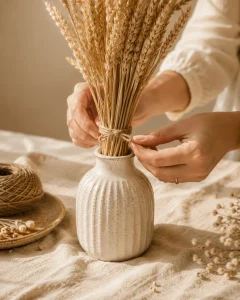
Project 1 — The dried-stem bundle in a ceramic vase (15 minutes)
The single most-leveraged DIY in the entire guide. A small bundle of dried wheat, pampas grass, eucalyptus, or any combination of three or four dried elements, tied with twine, placed in a ceramic vase. The result reads as a florist-styled arrangement. The work is in the proportions.
Method: Cut the dried stems to roughly one-and-a-half times the height of the vase. Group five to seven stems together. Tie with twine three inches from the bottom in a simple knot. Fan the top of the bundle slightly so the stems splay outward. Place in the vase.
The bought piece: The white textured face vase set” >white textured face vase set at ₹899 provides two vases — one bundle per vase, two rooms styled. The Beige Loop Vase with pampas grass” >Beige Loop Vase with pampas grass at ₹899 comes ready-styled if you do not want to assemble the bundle yourself.
Project 2 — The pebble dish on the entryway console (10 minutes)
A shallow ceramic dish, half-filled with small pebbles or stones in a single tonal range (cream, soft grey, beige), placed on the entryway console or the bedside table. The pebbles catch keys, the dish anchors the surface. Costs nothing if you collect the stones from one weekend walk.
Method: Choose stones in a narrow tonal range. Mix and match if you cannot find enough of one tone. Wash the stones with soap and let them dry overnight. Arrange in the dish in a single layer.
The bought piece: The Cat Heart Trinket Dish” >Cat Heart Trinket Dish at ₹599 or the Ceramic Star Trinket Tray” >Ceramic Star Trinket Tray at ₹699 are both correctly sized. The pebbles cost zero.
Project 3 — The muslin-wrapped gift presentation (5 minutes)
Useful for every birthday, every housewarming, every Diwali. A square of unbleached muslin folded around the gift using the Japanese furoshiki wrap. The wrap costs ₹15 per gift; the perceived thoughtfulness is enormous.
Method: Place the gift diagonally on a square of muslin. Lift the two opposite corners and tie them in a loose knot above the gift. Lift the other two corners and tie them in a second knot crossing the first. Trim the ends if they are too long. Attach a small kraft tag with twine.
The technique is genuinely simple. A two-minute YouTube tutorial covers it.
Project 4 — The kitchen-counter decant (30 minutes)
The transformation that turns a typical Indian kitchen counter from chaotic to composed without buying anything new. Decant your three most-frequently-used kitchen staples — rice, sugar, salt or atta — from their plastic bags into glass or ceramic jars on the visible counter. Hide the plastic bags inside the cupboard.
Method: Wash the jars and dry overnight. Pour the contents in, leaving an inch of headspace. Label with a small kraft tag tied around the neck of the jar. If you want to be elegant about it, write the label in capital letters with a black gel pen.
The bought piece: The hand-painted ceramic canister with wooden lid” >hand-painted ceramic canister with wooden lid at ₹999 holds 500g of staples and reads better than any glass jar. For the smaller spices, the ten-piece condiment jar set with tray” >ten-piece condiment jar set at ₹599 covers the masala layer.
Project 5 — The tea-stained paper labels (20 minutes)
Hand-lettered paper labels, lightly stained with cold tea or coffee to add a warm vintage tone, tied to jars or wrapped gifts with twine. The labels cost nothing. The visual effect is disproportionate.
Method: Cut small rectangles of brown craft paper or off-white card (3cm × 6cm works). Brew a strong black tea and let it cool completely. Dip the labels for two to three seconds, blot on a paper towel, let dry on a flat surface for 20 minutes. Write the labels in capital letters with a black gel pen. Punch a small hole at one end and thread with twine.
Use the labels for the decanted kitchen jars (Project 4), the wrapped gifts (Project 3), or as bookmarks-cum-tags on coffee-table books.
Project 6 — The muslin curtain for a window or shelf (45 minutes)
A single panel of unbleached muslin or raw cotton hung as a sheer curtain over a window, or as a soft front on an open shelf. Diffuses the light beautifully and hides the shelf chaos.
Method: Buy unbleached muslin from a textile shop — a metre of width by the height you need, around ₹100-200 per running metre. Cut to size. The simplest hang: fold the top edge over a length of twine and secure with safety pins at four-inch intervals. Tie the twine to two cup-hooks or two existing fixtures. If you cannot install hooks (renter), tape the twine to the wall on each side with strong removable tape — the muslin is light enough that the tape holds.
The same panel of muslin can hang as a backdrop for product photography, drape over a sofa as a throw, or fold into a stack of “napkins” for entertaining. One ₹200 purchase, four uses.
Project 7 — The single-frame photograph (20 minutes plus printing time)
One photograph, printed in black-and-white at A4 size at a local print shop (₹50-100), mounted with strong removable tape behind a single sheet of glass or acrylic from a local frame shop (₹100-200), hung with one Command Strip. No drilling required.
Method: Pick a photograph that already lives on your phone. Crop to a 4:5 ratio. Convert to black-and-white in any phone editor. Print at A4 on matte paper at a local print shop. Mount on the wall using a single Command Strip — no frame required, the bare printed paper reads correctly. If you want a frame, the cheapest IKEA-style frames at ₹500 work.
One framed photograph per wall is the quiet-luxury discipline. Three or five small framed pictures in a “gallery wall” is the opposite of the aesthetic.
Project 8 — The folded-throw drape (5 minutes)
A textile throw — a linen, a cotton dhurrie, or a woollen square — folded into a rough rectangle and draped over the arm or corner of a sofa, the foot of a bed, or the back of a chair. The fastest single styling move in the entire guide.
Method: The fold matters. Hold the textile at two corners and fold in thirds longways. Then drape over the corner of the sofa or bed at a slight diagonal, so one corner falls lower than the other. The asymmetry is the styling. A perfectly square fold reads as institutional; the slight imbalance reads as casual elegance.
Project 9 — The reading-nook composition (15 minutes)
A small side table, a single floor lamp, a chair you already own, and a small composed grouping of three objects. The reading nook does not require new furniture — it requires you to acknowledge that a corner of your living room is already a reading nook in disguise.
Method: Identify the chair where you actually read or scroll for thirty minutes a day. Place a small side table within arm’s reach. On the table: a hand-painted ceramic mug (Project 4’s decanted-tea version, or just your tea), a small ceramic bowl holding a single hardback book closed and your reading glasses, and one small object — a candle, a small vase, a folded napkin. Three objects. The table is allowed to feel slightly cluttered. Reading nooks that look like magazine photographs have never been read in.
The bought piece: A single hand-painted ceramic mug” >hand-painted ceramic mug (₹399), and a single small ceramic bowl” >ceramic bowl (₹449). Under ₹900.
Project 10 — The hand-lettered card (5 minutes)
Every gift, every housewarming visit, every birthday — a three-line hand-written card placed on top of the present. The card costs ₹5. The compound effect on perceived thoughtfulness is disproportionate.
Method: Buy small folded cards in unbleached or kraft paper from a stationery shop, ₹3-10 each. Write three sentences in capital letters with a black gel pen. The first sentence names the recipient or the occasion. The second sentence names the gift. The third sentence is personal.
The example structure from our housewarming guide: “Your new place. A cup for your morning coffee. I hope a hundred ordinary Wednesdays start here.” Three sentences, twenty seconds of writing, gift remembered for a year.
Project 11 — The candle-jar saver (10 minutes)
An old scented-candle jar, washed clean of wax, repurposed as a small storage container, pencil cup, or single-stem vase. The aesthetic upgrade comes from removing all branding and labels.
Method: Once the candle is burned down to the last quarter-inch, place the jar in the freezer for two hours. The remaining wax shrinks and pops out. Soak the jar in hot soapy water; the labels peel off in twenty minutes. Dry overnight. The clean glass jar reads as a small vase or pencil cup. Our own soy pillar candles, with reusable ceramic vessels, are coming later this year — coming to The Plush Republic later this year — until then, repurpose what you already have.
Project 12 — The single-stem flower swap (5 minutes, weekly)
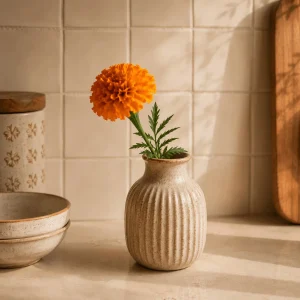
One fresh flower per week, placed in a small ceramic vase on the dining table or the kitchen counter. The flower costs ₹20-50 from a local thele wala. The visual effect is enormous.
Method: Pick one flower stem from a roadside vendor or your nearest flower market. Marigold in winter. Tuberose in summer. A single rose, a single chrysanthemum, a single sprig of jasmine. Trim the stem to fit your vase. Refresh the water every second day. Replace the flower weekly.
The single-stem move is the discipline. Five flowers in one vase reads as a bouquet; one flower reads as a styled choice. Bouquets are for occasions; styled choices are for everyday rooms.
The compounding move
Once the kit of materials is in your home and you have run through three or four projects, the compounding takes over. You will start to see DIY opportunities you did not notice before. A jar that arrives full of pickles will be earmarked, a month later, as a candle-jar saver. A walk to the post office will produce three stones for the entryway dish. A market run will end with a single marigold for the kitchen vase.
The aesthetic, in this DIY register, is not a series of projects. It is a habit of looking at the materials of daily life as a potential styling palette. Brown paper, twine, dried stems, glass jars, muslin squares, hand-lettered cards. The habit, once formed, makes the home steadily more composed over months and years, at almost zero ongoing cost.
What this guide does not promise
Three honest disclaimers. First, the projects above are styling projects, not construction projects. They will not give you new furniture or new walls. They will give you a more composed version of the home you already have.
Second, the result of these projects looks “aesthetic” only if the underlying objects are in the right palette. A DIY dried-stem bundle in a neon-orange plastic vase will not work. The investment in the small bought pieces — the ceramic vase, the trinket dish, the canister — is what lets the DIY land. Without those anchors, the projects read as crafts. With them, the projects read as composition.
Third, the projects assume some baseline aesthetic instinct. The exact placement of the dried-stem bundle, the precise drape of the muslin, the proportion of the pebbles in the dish — these are judgement calls. The guide can describe the technique; you have to develop the eye. Six weeks of consistent practice usually does it.
The shorter answer
Twelve projects. None requiring power tools. Most under thirty minutes. Each anchored by one small ceramic or styling piece that you do buy. The underlying philosophy: DIY aesthetic decor is not skilled craftsmanship; it is material choice and composition. Choose well and even the simplest project (a dried bundle in a vase, a single flower on the kitchen counter) reads as expensive styling.
If you have an hour this Saturday: Project 1 (dried-stem bundle), Project 4 (kitchen decant), and Project 12 (single-stem flower). Three projects, three rooms transformed, total bought-piece cost under ₹2,400 if you start from zero.
Browse the home decor collection” >home decor collection for the anchoring ceramic pieces that make each DIY land.
Back to journal