The Indian housewarming — the griha pravesh, the kudipuga, the palli kondu — is one of the more honest social occasions left in this country. People come to a home that has not yet learnt the habits of its owners. The kitchen is still finding its rhythm. The bathroom shelf is bare. There is a smell of new paint that everyone politely ignores. Into this in-between moment a guest arrives, hands you a gift bag, and watches your face. The exchange is not really about the object inside the bag. It is about whether you saw the home you were walking into and whether the thing you brought belongs there.
This guide is built on a single conviction: a housewarming gift should make the recipient’s ordinary mornings feel slightly more considered, and it should do so for years. Not weeks. Not the half-life of a scented candle. Years. Everything below has been chosen on those terms.
The principle: useful luxury, not decorative tokenism
The default housewarming gift in most Indian cities is one of three things: a heavy box of sweets, a faux-velvet wall hanging featuring a deity, or a brass diya set still in its plastic. Two of these get consumed in a week. The third gets stored in a cupboard with the words “we’ll find a place for this later” and is rediscovered, unused, during the next move. All three fail the same test. They were chosen for the moment of giving, not for the years of using.
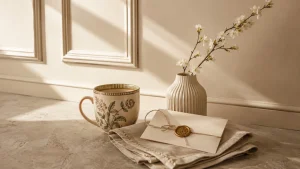
Useful luxury is the opposite philosophy. The piece must be something the recipient will reach for. A coffee mug they pick on a Wednesday morning over the four other mugs in the cupboard. A bowl that becomes the one the family uses for evening fruit. A vase that earns its corner on the console because a single stem looks right in it. Use is the only honest measure of a good gift.
This is what we mean when we say affordable luxury at The Plush Republic — not the cheapest version of a luxury object, but the smallest object that quietly raises the standard of a daily ritual. A mug you actually like holding. A bowl whose weight feels correct in the hand. The kind of piece that survives the move to the next apartment because it has earned its place.
Use is the only honest measure of a good gift.
The budget framework
Indian housewarming gifting falls into three honest budget tiers. Below ₹1,500 is the “single statement piece” band — one beautiful object that announces itself without trying. Between ₹1,500 and ₹3,000 is the “curated set” band — two or three coordinated pieces that solve a problem in the recipient’s daily life. Above ₹3,000, up to about ₹5,000, is the “foundation” band — a multi-piece curation that becomes part of the home’s actual infrastructure: a dinnerware set, a tea service, a kitchen storage suite.
The trap most gifters fall into is treating these as price tiers when they are actually occasion tiers. A ₹500 gift to an old college friend with a 1BHK in Bandra is genuinely considerate. The same ₹500 gift to a senior at work who has just moved into a duplex in Whitefield reads as offhand. Calibrate to the relationship, not just the rupee.
Under ₹1,500: the single statement piece
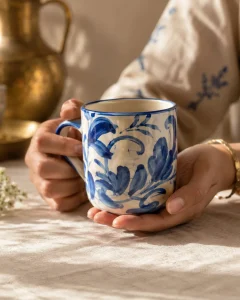
The trick at this budget is to resist buying volume. Two cheap candles in a giftbox always look worse than one excellent object. Pick one piece with presence. A hand-painted ceramic mug in an unusual shape — a heart-handled cup, a ribbed stoneware tea cup, a deep-glazed coffee mug with an unexpected rim — does more work at ₹349 to ₹699 than a four-piece set of generic giftware at the same price.
The hand-painted ceramic mug collection” >hand-painted ceramic mug collection from Mannat Ceramics, Khurja is built for this band. Each piece is one of a small batch, hand-glazed, with painting variations that mean no two are identical. For a friend who lives alone and drinks coffee at a window every morning, a single ₹399 mug in a tone that matches their kitchen will be used four hundred times this year. A scented candle will be lit twice and then forgotten on a shelf.
A small ceramic bowl works in the same way. The bowl collection” >bowl collection includes pieces in the ₹399 to ₹699 range — the kind of object that begins life as a fruit bowl on the dining table and ends up on a desk holding paperclips, then on a console holding keys, then back on the dining table holding salt. Bowls of the right size are remarkably mobile inside a house. That mobility is what makes them survive.
A trinket dish in this price band is the most under-appreciated housewarming gift in Indian gifting. The Cat Heart Trinket Dish” >Cat Heart Trinket Dish at ₹599 lives on a bedside table catching earrings, on an entryway console catching keys, on a desk catching pen caps. It costs less than a takeaway dinner and is touched daily for a decade.
The wrapping at this price band matters disproportionately. A single ₹399 mug presented in a kraft-paper sleeve with a hand-written card lands better than the same mug rattling around in a generic gift box. We’ll come back to wrapping at the end of this guide.
₹1,500 to ₹3,000: the curated set
Once the budget moves past about ₹1,500, the gift transitions from “one beautiful object” to “two or three pieces that solve a problem.” The problem is usually one of these: the recipient does not yet own a set of nice mugs they would put out for guests. They have plates but no serving bowl that looks worth photographing. They have a kitchen counter that is functionally fine but visually chaotic — too many plastic containers, too many mismatched jars.
For the mug problem, a set of ten hand-glazed cups” >set of ten hand-glazed cups in coordinated tones (around ₹2,500 for the pair-set variants) is the genuine answer. Ten is the right number for an Indian home — it covers the family plus one guest, with two spares for the inevitable chip. Buying the same set yourself feels indulgent. Receiving it as a gift feels considered.
For the serving problem, a ten-piece bowl set” >ten-piece bowl set at ₹1,099 is the most economical anchor for a tea-and-snacks ritual. The recipient lays them out for guests once and never goes back to mismatched cereal bowls again. Pair it with a small vase — the white textured face vases, set of two” >white textured face vases at ₹899 work beautifully on a sideboard — and you are at ₹2,000 with two distinct categories addressed.
For the kitchen-counter problem, the answer is storage that you want on display. A hand-painted ceramic canister with wooden lid” >hand-painted ceramic canister with wooden lid at ₹999, paired with a ten-piece condiment jar set on a tray” >ten-piece condiment jar set on a tray at ₹599, takes the kitchen from functional to composed for under ₹1,600. The recipient stops shoving the masala tray into a cupboard before guests arrive. The kitchen looks ready by default.
If the recipient is the kind of person who hosts informally — pulls people in for chai and biscuits unannounced — a ten-piece purple ceramic tea set” >ten-piece purple ceramic tea set at ₹449 is the rare gift that pays back immediately. Within a fortnight, somebody’s mother has been served chai in it, and the gift has done its job.
₹3,000 to ₹5,000: the foundation set
At this budget the gift becomes structural. It earns a place in the recipient’s home that is permanent — the dinnerware they pull out for every birthday for the next ten years, the tea set that becomes the family’s “good service,” the kitchen suite that anchors a counter.
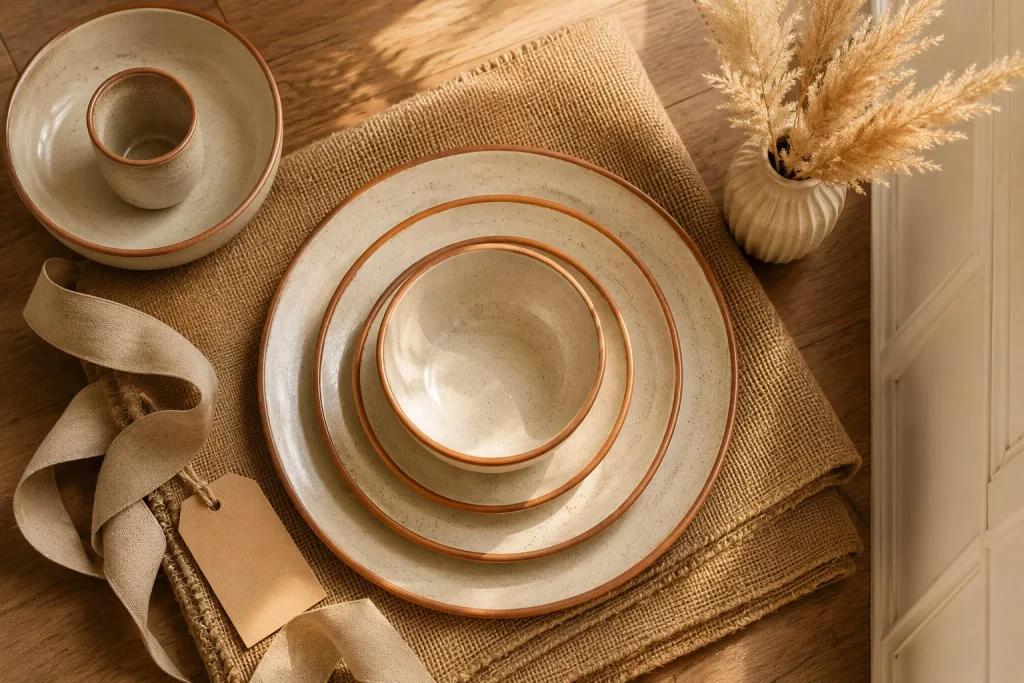
The Woodland Floral Terracotta Rim Dinnerware Set” >Woodland Floral Terracotta Rim Dinnerware Set at ₹1,999 is the single highest-impact piece in our catalogue at this band. It is dinnerware that is photogenic enough for the recipient’s Sunday brunch reels and durable enough for everyday use. Pair it with the Beige Ceramic Loop Vase with pampas grass” >Beige Ceramic Loop Vase with pampas grass at ₹899 and a small bowl set, and you have built a ₹3,500 foundation gift that solves two problems at once: how the recipient’s table looks, and how the corner of their dining room reads.
The other ₹3,000-plus configuration is the kitchen suite. The canister, the condiment set, a pair of vases, and a serving bowl — picked in a coordinated palette — runs to about ₹3,800 and makes the kitchen counter look like something. A first-apartment renter will not buy this themselves for the first three years. A gift that compresses three years of taste acquisition into a single box is genuinely valuable.
By recipient: a calibration guide
Newlyweds in their first home together
The temptation is to gift a deity figurine or a wall hanging. Resist. A newlywed couple is building their aesthetic, not their parents’. The most useful gift is one that lets them play house together — a tea set they can serve their first set of visitors with, a dinnerware foundation that signals “we are now a household that owns nice things.” The Woodland Floral dinnerware set” >Woodland Floral dinnerware set is almost custom-built for this brief.
If you know the couple well: ask one of them what colour they painted the kitchen. Then match the gift palette to it. This sounds trivial. It is not. A gift that visibly matches the home it lands in is read, correctly, as having been chosen.
Parents who have downsized to a smaller flat
Downsizing is loaded. The parents have given away two-thirds of their things and are now living in a space that does not yet feel theirs. Avoid bulky gifts. Avoid anything they cannot easily display in a 1BHK. A pair of small textured face vases” >small textured face vases at ₹899 is the right register — they take up an eight-inch footprint on a sideboard, they photograph well, and they signal “we noticed your new life is more compact and we’re celebrating it, not lamenting it.”
Tea is the universal Indian downsizing solvent. The ten-piece tea set” >ten-piece tea set works here too, because parents who have downsized still receive their old friends. The set lets them keep that hospitality going without having to apologise for “the new place still being half-empty.”
First-apartment renters
The constraint is that the recipient cannot put nails in the walls and probably has very little storage. The right gift is small-footprint, high-frequency-use, and not breakable in the next move. A single beautiful mug, a small bowl, a trinket dish. Under ₹1,000. Wrapped well. The renter is twenty-six, broke, and will photograph the gift for their story within twenty minutes of you leaving.
The family that “already has everything”
This is the hardest brief. The family has been married twelve years, owns four sets of dinnerware, has cycled through three coffee table styles. The honest move is to give something they would never buy themselves — a single sculptural vase, a one-off hand-painted piece. The vase collection” >vase collection exists for precisely this. A vase is the rare object whose value is almost entirely aesthetic, which makes it both the easiest thing to dismiss and the easiest thing to surprise with.
Return gifts: when the recipient becomes the host
The Indian housewarming has an inverted gifting layer most overseas guides miss entirely. The host gives the guest something to take home. Return gifts at housewarmings are usually one of two things: a small sweet box, or a generic memento like a keychain. Both are forgettable.
A better return-gift principle: pick one small ceramic object, multiplied across the guest list. A trinket dish per family, a single hand-painted mug per couple, a tea cup per single guest. The economics work out at scale — a 30-guest housewarming with the Cat Heart Trinket Dish” >₹599 trinket dish as a return gift costs about ₹18,000, comparable to what most families spend on a generic sweet-box-plus-keychain combination. The difference is that each guest leaves with an actual object that earns its place in their own home.
For larger guest lists, the ten-piece bowl set” >ten-piece bowl sets can be broken into singles for return gifts — ten guests served from one set, at ₹110 per piece. This is the rare gifting move that is both economical and seriously considered. We work with families on bulk return-gift orders through our Corporate Gifts programme” >Corporate Gifts programme.
What not to give
Some categories fail the housewarming brief in predictable ways. A short list, with reasoning.
Decorative figurines, regardless of price. Figurines are difficult to place in a home that has not yet found its style. They sit on a shelf the recipient is still composing. They date quickly. The hit rate on figurines as gifts is the worst in the entire gift category.
Heavily fragranced candles. Most Indian guests will encounter at least one person at the housewarming with allergies or migraines. The candle ends up regifted. Soy candles in our own restrained palette — coming to The Plush Republic later this year — until then, skip the perfume layer.
Framed photographs. The recipient has not yet decided which wall is the photo wall. A framed gift forces them to either hang it (against their plan) or store it (which they will feel guilty about).
Religious iconography that isn’t already in their home. Faith is specific. Gifting a deity the recipient does not worship — even with the kindest intent — creates an obligation they did not ask for. If the family already has a clear practice and you want to honour it, gift a single excellent diya or a brass bell. Stay neutral otherwise.
Anything with the giver’s name on it. Personalised gifts work — but the personalisation should be the recipient’s initial, never the giver’s. The recipient is the protagonist of the housewarming. Keep it that way.
Wrapping, presentation, and the card
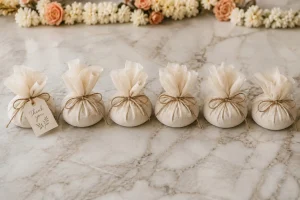
A ₹399 mug wrapped in tissue paper inside a kraft sleeve, tied with twine, accompanied by a hand-written card outperforms a ₹2,000 gift inside a generic plastic gift bag. The economics of presentation are absurd at this scale. Twine costs ₹40 a roll. A hand-written card costs ten minutes. The compound effect on perceived thoughtfulness is large.
A practical wrapping kit: unbleached muslin or cotton fabric (a half-metre square for most pieces), a length of cotton twine, a small kraft tag, a black ink pen. Fold the muslin around the object using the furoshiki wrap — diagonal corners knotted on top — and tie the tag with twine. Total cost per gift: about ₹80. Total time: under three minutes once you have the kit.
The card matters. Write three sentences. The first names the home: “Your new place.” The second names the object: “A cup for your morning coffee.” The third is personal: “I hope a hundred ordinary Wednesdays start here.”
That is the entire trick. Name the home. Name the object. Name the wish.
The shorter answer
If you are reading this two hours before a housewarming and need a single recommendation: a hand-painted ceramic mug under ₹500, wrapped in muslin, with a three-line card. It works for almost every recipient, almost every budget, almost every relationship. Use is the only honest measure of a good gift — and a mug used twice a day, every day, for the next decade, is a gift that keeps proving itself.
Browse the full gifting collection” >full gifting collection or the curated gift sets” >curated gift sets for more options across all three budget tiers.
Back to journal