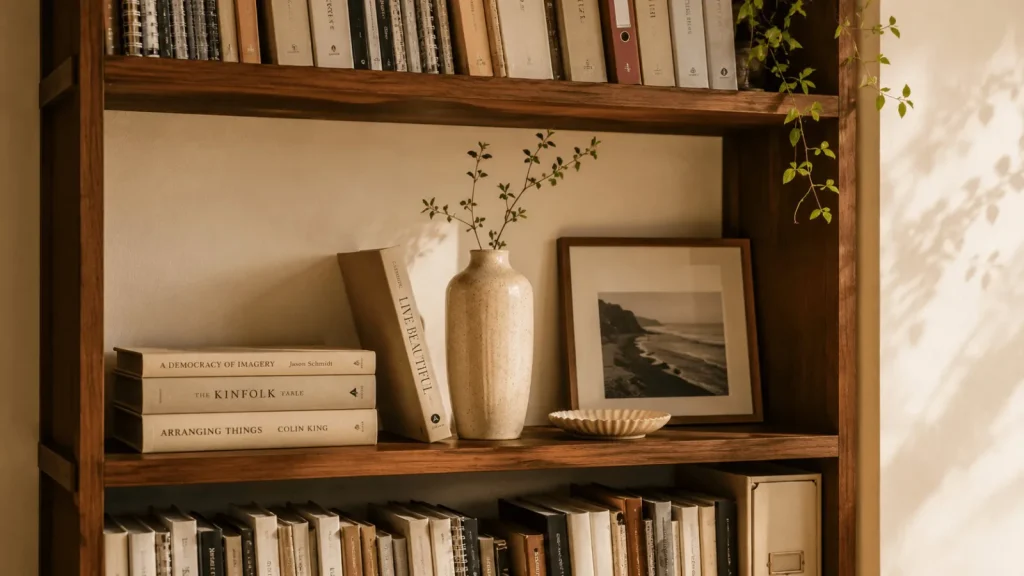
A “shelfie” is the open-shelf vignette photographed front-on for Instagram or Pinterest. The shelf is usually one of two things: the second-from-top shelf of a tall bookshelf, or a single floating shelf in a kitchen, living room, or bathroom. The category is small but its visual influence is large — the shelfie is the most-shared format in contemporary home-decor social media. It is also the most-misunderstood. The Pinterest version overloads the shelf with twelve to fifteen small objects in coordinated colours. The honest version is built from much less.
This guide gives you nine working shelfie vignettes, each one composed mostly of objects you already own (books, kitchen ceramics, a folded napkin, the occasional plant), augmented by one or two small ceramic pieces that anchor the composition. No shelf-renovation, no new construction, no bespoke shelving. The vignettes are designed for the open shelves you already have.
The principle: one shelf, five-to-seven objects, three groupings
The shelfie operates on a tighter version of the coffee-table styling rules. The shelf is smaller in surface area, the viewing angle is fixed (head-on, not overhead), and the depth of field is limited. The discipline is:
One shelf at a time. Style a single shelf well rather than every shelf badly. A bookshelf with one carefully composed shelf reads as intentional even if the surrounding shelves are functional storage.
Five to seven objects total. Counted across the whole shelf. Fewer is acceptable; more is over-styled.
Three visual groupings. A left grouping, a centre grouping, a right grouping, with visible breathing room between them. The same rule as coffee-table styling, scaled to the shelf.
Height variation within each grouping. A taller object, a medium object, a low object. Books standing vertically, a leaning hardback, a small ceramic dish. The height triangle inside a single grouping is what makes the shelf feel composed rather than flat.
One shelf at a time. Five to seven objects total. Three visual groupings with breathing room between them.
The nine vignettes
Vignette 1 — The all-books shelf with a single ceramic punctuation
The simplest shelfie and the one most homes can build in five minutes. A row of hardback books stacked vertically (spines facing out, not pages), with one stack of three or four books on its side, topped with a single small ceramic object. The horizontal book stack breaks the vertical rhythm; the ceramic on top is the focal point.
Setup: Six to eight hardback books standing vertically on the right two-thirds of the shelf. A stack of three hardback books lying flat on the left third. On top of the lying stack: a single Cat Heart Trinket Dish” >Cat Heart Trinket Dish at ₹599, or a small ceramic bowl.
Total cost: ₹599 plus existing books. The shelf reads as styled in under three minutes.
Vignette 2 — The two-vase shelf
One tall vase, one short vase, on a single shelf, with a small grouping of books between them. The composition reads as a balanced asymmetry — the eye travels from one vase to the other across the book stack in the middle.
Setup: One textured face vase from the set of two” >textured face vase at the left, slightly taller (or with a single dried stem); one the other textured face vase” >the other textured face vase at the right, shorter (or empty); a stack of two flat books in the centre with a small bowl on top.
Total cost: ₹899 for the vase pair plus existing books and a bowl. The vase pair does most of the styling work; the books fill the structural gap.
Vignette 3 — The kitchen open shelf
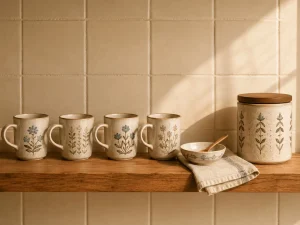
The kitchen open shelf — common in newer Indian flats and in renovated apartments — is one of the highest-leverage shelfie surfaces. The functional objects (mugs, bowls, small dishes) are also the styling objects. The discipline is to display the items you actually use rather than the items you bought to display.
Setup: Four hand-painted ceramic mugs from the mug collection” >mug collection standing in a row on the left two-thirds (₹399 × 4 = ₹1,596). The ceramic canister with wooden lid” >ceramic canister at ₹999 on the right end. A small ceramic bowl between the mugs and the canister, holding the sugar spoon. A folded linen napkin tucked under the bowl.
Total cost: ₹2,995 from our catalogue. The kitchen open shelf transforms from “where the mugs live” to “the most photographed shelf in your home.”
Vignette 4 — The bathroom shelf
The bathroom shelf is small (typically 6-10 inches deep) and the styling load is correspondingly small. The trick is to replace the visible plastic packaging with ceramic and glass alternatives.
Setup: A small ceramic bowl” >ceramic bowl at ₹449 holding the bar soap. A glass jar (repurposed from a kitchen jar) holding cotton buds. A folded white linen face cloth. A small ceramic trinket dish” >trinket dish at ₹599 holding rings before showering. Amber-glass soap dispensers, our own version, are coming later this year — coming to The Plush Republic later this year — until then, the bowl holds a bar soap or a decanted hand-soap in a reused glass jar.
Total cost: ₹1,048 from our catalogue. The bathroom shelf transforms from “where the shampoo bottles cluster” to “a small composed scene that looks like a hotel.”
Vignette 5 — The bedside shelfie
The bedside table or the small shelf above the bed. The discipline: maximum three objects, all functional.
Setup: A small ceramic trinket dish” >trinket dish at ₹599 for the watch and the wedding band. A single hardback book stacked flat (a book you are actually reading or one you have read recently). A small ceramic bowl on top of the book for the reading glasses or the phone overnight.
Total cost: ₹1,048 plus existing books. The bedside shelf becomes a small composed scene rather than a cluttered repository of phone-chargers and water glasses.
Vignette 6 — The living-room floating shelf
A single floating shelf, sometimes installed above a sofa or in a small alcove, sometimes the existing shelf above a TV cabinet. The styling is the most “intentional” of all the shelfie categories because the shelf has no functional default.
Setup: The Beige Loop Vase with pampas grass” >Beige Loop Vase with pampas grass at ₹899 on the right end (the height anchor). A stack of three hardback books on the left, with a small ceramic trinket dish” >ceramic trinket dish at ₹599 on top. A single leaning hardback book or a small framed photograph leaning against the back wall in the centre.
Total cost: ₹1,498 from our catalogue plus existing books. The floating shelf becomes a focal point of the living room.
Vignette 7 — The work-from-home shelfie
The shelf above the work desk. The discipline: nothing that competes with the screen for attention during work hours, but enough composition that the shelf looks intentional in any video-call background.
Setup: A row of three to five hardback books standing vertically (work-relevant or general; non-fiction reads better than fiction in video calls). One small ceramic bowl” >bowl at ₹449 for paperclips or USB sticks. A single small textured ceramic vase” >small textured ceramic vase at ₹449 (treat the pair as buy-one-keep-one-elsewhere) with a single dried stem.
Total cost: ₹898 from our catalogue plus existing books. The video-call background gains a quiet personality.
Vignette 8 — The dining sideboard shelf
The dining sideboard or credenza often has one or two shelves at the top (open) and storage below (closed). The open shelf is styled; the closed storage holds the actual dinnerware.
Setup: The white textured face vase set of two” >white textured face vase set of two at ₹899, used as a pair on this shelf (the rare time the matching-pair rule is broken). A row of three or four small ceramic bowls” >bowls in coordinated tones, stacked one on top of the other, between the two vases. A small folded linen napkin or runner beneath the entire composition.
Total cost: ₹899 for the vases plus the existing bowls. The sideboard shelf becomes the formal styled element of the dining area.
Vignette 9 — The “shelf you forgot existed”
Every Indian home has at least one shelf that has accumulated random objects over years — the entryway shoe-rack top, the top of the fridge, a built-in alcove near a window. The vignette is the rehabilitation of one of these shelves.
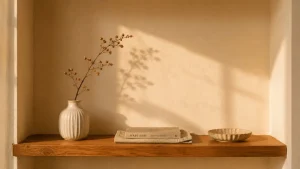
Setup: Clear the shelf completely. Place a single ceramic vase” >ceramic vase at ₹449 on one end with a dried stem. Place a ceramic trinket dish” >ceramic trinket dish at ₹599 at the other end. Place one folded textile or one small book in the middle. Stop.
The “shelf you forgot existed” becomes the surface most guests comment on, because it is the surface they did not expect to be styled.
The book-spine discipline
Books are the most common shelfie material and the most often misused. Three rules.
One — choose books for the spine, not the content. When books are part of the styling, the spine is the visible element. Choose hardback editions with cloth or paper bindings in tones that match the room palette. Mass-market paperbacks with bright glossy covers read badly. Cloth-bound classics, art monographs, photography books, and hardback fiction with restrained spine typography read well.
Two — colour-block the spines. Group books by spine colour rather than by author or topic. Three cream-spined books together, three deep-red spines together, three near-black spines together. The grouping reads as intentional even if the underlying content is mixed. Library science purists object; the eye does not.
Three — limit the heights. Within a single shelf, the books should be in approximately three different heights. All-same-height books create a visual wall; all-different-height books create chaos. Three heights — tall, medium, short — give the eye structure without monotony.
The photography setup
The shelfie exists as much for the photograph as for the room. Once styled, a few minutes of photography turns the shelf into a shareable image. The setup:
Time of day. Late morning or mid-afternoon. The light is warm but not low. Avoid mid-day (light too white) and evening (light too yellow).
Camera angle. Head-on, at the centre vertical of the shelf. Not at an angle. Not from above. The shelfie is a flat, frontal photograph.
Lighting. Natural side-light from a window perpendicular to the shelf. The shadows from one side give the composition depth. Avoid direct overhead lighting and avoid the harsh white light of ceiling tubes.
Camera setup. A smartphone camera, no flash, in portrait orientation. Tap to focus on the centre of the composition. The depth of field should be roughly the full depth of the shelf — if your phone has a portrait mode, do not use it, because portrait mode will blur the back of the shelf and you want the entire scene in focus.
Post-processing. Minimal. Slight contrast increase, slight warmth increase, no filter. The light has already done the work; over-editing flattens it.
What people get wrong
Over-symmetrical compositions. Two identical objects on either side of the shelf, with one centred object between them. The result reads as a hotel display rather than a personal shelf. Break the symmetry — use a pair of vases but place them at slightly different heights or with different stem-heights.
Matching colour overload. The Pinterest version of shelfie-styling often shows shelves where every object is in the same tonal range — six cream vases, twelve cream books, four cream dishes. The composition reads as flat because there is no tonal contrast. Introduce one darker accent (a near-black ceramic, a deep-red book spine) and the entire shelf gains depth.
Plant overload. One small plant per shelf is fine. Three or four trailing plants over one shelf is a botanical exhibit. Plants on shelves are also functionally problematic — they drip water, they need rotating for light, they shed leaves. A single small plant or a vase with dried stems is the discipline.
Photography-only styling. Styling the shelf only for the camera angle and ignoring how it looks from the side or from across the room. The shelfie has to read correctly from multiple positions in the room, not just from the photographer’s exact spot.
Once-and-done thinking. Styling the shelf in October and assuming it stays. The shelfie needs small rotation every quarter — swap one book, change the dried stem, rotate one ceramic in and out. The shelf stays alive.
The shelfie as social object
The reason shelfies have outsized social visibility is that they are the most signal-rich domestic image. A shelfie shows, in one frame, what the person reads, what they own in ceramic and art, what they value enough to display, and how they think about composition. This is more information than any other single domestic photograph. Coffee-table styling shows taste in objects. The shelfie shows taste in objects and in priorities.
This is why the shelfie has become a kind of micro-portrait. Someone’s living-room shelfie tells you whether they read non-fiction or novels, whether they prioritise old ceramics or new design objects, whether they keep family photographs visible or private. It is, in a small way, a CV of the home-maker.
Treat it as such. The shelf is allowed to be your taste rendered visible. The constraint is the same as for the entire aesthetic philosophy of the home — fewer objects, better chosen, in a coherent palette, photographed in honest light.
The shorter answer
One shelf at a time. Five to seven objects. Three groupings with breathing room. Height variation within each grouping. Books chosen for their spines. One ceramic anchor per grouping. One organic element, no more. Photograph in late-morning side-light.
The two-piece starter kit — the textured face vase pair (₹899) and the trinket dish (₹599), under ₹1,500 — covers seven of the nine vignettes above. Browse the home decor collection” >home decor collection for the ceramic anchors that turn an ordinary shelf into a shareable shelfie.
Back to journal