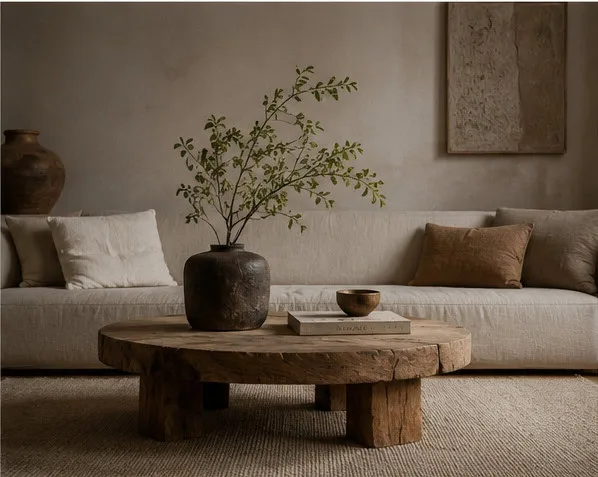
Wabi-sabi is the most mistranslated Japanese aesthetic in the English-language home-decor canon. Every Pinterest board labelled wabi-sabi shows the same six images: a beige linen sofa, a single dried branch in a tall vase, a roughly thrown ceramic bowl, an unmade bed, a wooden tray, a square of natural light on a clay wall. The images are not wrong. But they have been pulled so far from the underlying idea that they now describe a colour palette rather than a philosophy.
This guide is for the Indian reader who has been hearing the word for two years, has a vague sense it has something to do with imperfection, and would like a serious account of what the aesthetic is, where it came from, and how to build the look at home without spending sixty thousand rupees on imported Japanese pottery.
What wabi-sabi actually is
Wabi-sabi is a Japanese aesthetic and worldview that finds beauty in three specific things: imperfection, impermanence, and incompleteness. Wabi originally referred to the loneliness of living away from society — the rustic simplicity of a small hut, a single tea bowl, the discipline of having little. Sabi referred to the patina of age — the bloom on bronze, the moss on stone, the way a wooden floor darkens over decades. Together, the term names a beauty that is asymmetric, weathered, modest, and accepting of its own decay.
The aesthetic emerged out of sixteenth-century Japanese tea culture, where the tea master Sen no Rikyū rejected the imported Chinese porcelains of the imperial court in favour of rougher Korean and locally-thrown Japanese tea bowls. The deliberate choice of the modest over the ornate is the founding move of the entire aesthetic. Rikyū was not interested in the rough bowl because he could not afford the imperial porcelain. He was interested in it because the rough bowl was a more honest object.
This matters for two reasons. First, wabi-sabi is not “cheap rustic.” It is a deliberate aesthetic position, taken in full awareness of the alternatives. Second, the original move was to choose local over imported, handmade over industrial. An Indian home that imports Japanese ceramics to be wabi-sabi has misunderstood the aesthetic at its root. The honest move is to choose well-made local pieces and let them age.
Wabi-sabi is not cheap rustic. It is a deliberate aesthetic position, taken in full awareness of the alternatives.
The three principles, made operational
1. Imperfection over symmetry
A wabi-sabi room is asymmetric. The styling on a console table is not balanced left-and-right with matching objects. The vase is off to one side. The stack of books is off-centre. The eye finds the composition because the objects are good, not because they have been mirrored.
In practice: when styling a surface, place your tallest object two-thirds of the way along the length, not in the middle. Place your second object slightly forward of the first, not directly beside it. The composition reads as arrived at rather than arranged. Hand-painted ceramics support this principle naturally — no two pieces in a small-batch run are identical, which means the symmetry is broken before you have even started styling.
2. Impermanence over preservation
A wabi-sabi home accepts that everything in it is in some stage of decay, and treats that decay as continuous with the object’s aesthetic. The wooden floor is meant to scratch. The brass tambler is meant to tarnish. The ceramic mug is meant to chip on the rim eventually. The hand-painted glaze is meant to soften with a thousand washes.
In practice: stop hiding scratches and signs of use. Do not buy four sets of dinnerware to avoid the daily set wearing out. Buy one good set, use it daily, and let it earn its small wounds. The Japanese tradition of kintsugi — repairing broken pottery with gold lacquer to make the break itself the most beautiful part of the object — is the most articulate version of this idea.
3. Incompleteness over fullness
The most counter-intuitive principle. A wabi-sabi room is deliberately under-furnished, under-styled, under-decorated. The empty wall is not a wall waiting for a painting. The empty corner is not a corner waiting for a plant. The empty surface is not a surface waiting to be styled. Space, in wabi-sabi, is a positive design element — the silence between two notes of music.
In practice: remove. Take three objects off your console table. Take the second vase off the sideboard. Take the framed family photographs off the bedroom dresser. Live with the emptiness for a week. The eye recalibrates. The objects you keep gain presence in proportion to what you took away.
The palette and materials
The wabi-sabi palette is the colour of natural materials in late afternoon light. Clay browns. Cream linens. The grey of unbleached cotton. The soft black of old iron. The brown-green of moss. The colour of paper that has aged for a hundred years. No high-saturation colour. No glossy finish. No chrome. No mirrors. Reflective surfaces, where they exist, are matte — the surface of a piece of brass after twenty years, the surface of a stoneware glaze, the surface of unvarnished wood.
The materials are equally specific. Stoneware, n
ot porcelain. Linen, not synthetic. Unfinished or hand-finished wood, not laminate. Hand-thrown clay, not slip-cast. Brass with patina, not chromed steel. Cotton paper, not glossy print. The principle is simple: every material should be able to age visibly.
What does not belong in a wabi-sabi room: glossy ceramics with mirror-smooth glazes, anything made of plastic that imitates another material, framed mass-produced art, glass-and-chrome lamps, polyester rugs, anything labelled “marble effect.”
Building the look in an Indian apartment
An Indian apartment carries a quiet advantage in this aesthetic. The cream wall paint that is the default in most rentals is already in the wabi-sabi palette. The Kota stone or terracotta floors found in older buildings are perfectly aligned. Even the standard Indian wooden furniture — teak, sheesham, mango wood — is naturally in the right family.
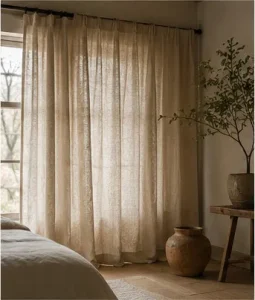
The work is less about adding new materials and more about subtracting the wrong ones. A wabi-sabi conversion of a typical Indian rental starts with three removals: the synthetic curtains (replace with unbleached cotton or linen), the polyester rug (replace with a hand-woven cotton dhurrie), and the framed mass-produced wall art (replace with nothing, or with a single hand-thrown bowl on a low shelf).
The hand-painted ceramic question
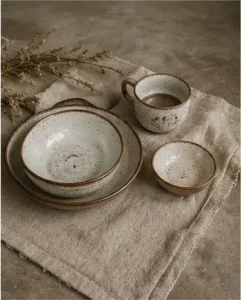
Wabi-sabi is often described in monochrome — beige and clay and cream and nothing else. This is a misreading. The original Japanese tea bowls were often quite richly glazed, with deep iron blues and oxidised greens. The principle is not no colour; it is no high-saturation industrial colour. A hand-painted blue motif on a cream stoneware mug is genuinely wabi-sabi. A neon turquoise machine-printed mug is not.
The hand-painted ceramic mug collection” >hand-painted ceramic mug collection from Mannat Ceramics, Khurja” >Mannat Ceramics, Khurja sits inside this principle. Each piece is small-batch, hand-glazed, with painting that varies slightly between cups. The ribbed-and-speckled mugs in stoneware white and sand are the most directly wabi-sabi pieces we carry. The hand-painted blue line cat bowl carries a more playful register but still reads correctly because the painting is visibly hand-applied.
If you want a single starter piece for wabi-sabi at home, the white textured face vase set” >white textured face vases at ₹899 do disproportionate work. The texture of the glaze breaks the symmetry, the off-white tone sits exactly in the palette, and the unusual silhouette — abstract faces — gives the eye something specific to land on without becoming ornate.
Room-by-room application
The living room
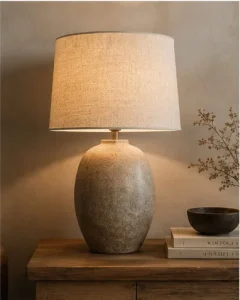
The living room is the hardest room to wabi-sabi because it carries the most stuff. The discipline is to clear the coffee table to a single object — a small hand-painted bowl, a single vase, a stack of two books and a ceramic dish on top. Clear the side tables to nothing at all, or to a single lamp with a paper or linen shade. Remove all but one frame from the wall.
The sofa cushions matter. Replace any polyester-blend cushion covers with unbleached cotton or linen. Three cushions on a three-seat sofa is the right number. Five is over-styled.
The dining area
The dining table is allowed one centrepiece object when not in use — a low ceramic bowl, a single vase with a branch, a small dish. When in use, the table is clear except for what is being eaten. The discipline is the daily decision to put the cooking pot back in the kitchen instead of leaving it on the table.
The Woodland Floral Terracotta Rim Dinnerware Set” >Woodland Floral Terracotta Rim Dinnerware Set sits within the wabi-sabi register — the terracotta rim is a clay reference; the hand-painted floral is asymmetric in execution; the white base is correctly in palette.
The bedroom
Bedrooms convert quickly because they already have less stuff. The two main moves: replace the bedspread with an unbleached cotton or linen one in cream, oatmeal, or muted clay; remove any framed photographs from the bedside table. A single hand-painted ceramic bowl on each side, holding the watch and the reading glasses, is the right styling load.
If you want a single decorative object in the bedroom, a small vase with a dried branch on the dresser is the safest move. The dried branch outlasts the busy weeks. Pampas grass, dried wheat, or a single bare twig in winter are all correct.
The kitchen
The wabi-sabi kitchen is the hardest brief because the kitchen has so many functional plastics. The discipline: visible storage in ceramic or glass. The hand-painted ceramic canister with wooden lid” >hand-painted ceramic canister with wooden lid at ₹999 takes one bag of basmati rice out of the plastic bag and into the visible counter. The ten-piece condiment jar set” >condiment jar set at ₹599 does the same for the dozen masala packets you currently keep in a drawer.
The visible counter then reads as composed clay objects rather than plastic packets. The drawers can still hold the plastic — they just stop being visible during a meal.
The bathroom
The bathroom is a high-leverage room — the smallest in the house, the easiest to clear, the surface most cluttered with shampoo bottles and toothpaste tubes. The move is to decant. Soap into a ceramic dish. Cotton buds into a small ceramic mug. A folded linen hand towel where the plastic one used to be. Amber glass soap dispensers and bath salt jars are coming to our catalogue later this year — coming to The Plush Republic later this year; for now, an unbranded glass jar from your kitchen does the same work.
What people get wrong
Three predictable mistakes in self-styled wabi-sabi homes.
Over-symmetry. A pair of matching vases on either side of the bed is not wabi-sabi. The principle is asymmetric composition. Use the vases on different surfaces, in different rooms.
Over-naturalism. A wabi-sabi room does not need a houseplant in every corner. The aesthetic is sparse. One or two well-placed plants — or one or two well-placed dried arrangements — is correct. Six is a jungle.
Over-rusticity. Wabi-sabi is not “farmhouse.” It is not exposed brick walls, distressed wooden shutters, and burlap sacks. The aesthetic is restrained, urbane, and disciplined. A wabi-sabi room can sit comfortably in a high-rise apartment in Bandra or Indiranagar — it does not require a heritage haveli.
Kintsugi and the philosophy of repair
The most articulate single expression of wabi-sabi is the Japanese tradition of kintsugi — the practice of repairing broken ceramics with lacquer mixed with powdered gold. The repaired piece is not hidden. The break is celebrated. The gold seam traces the line of damage and makes it the most visually arresting feature of the entire bowl. The philosophical position is that the object’s history is part of its beauty, and pretending the damage did not happen is a refusal of the aesthetic itself.
Applied at home: when your hand-painted ceramic mug develops a small chip, do not throw it away. Continue to use it. The chip is now part of the object. If you are inclined, you can repair it with food-safe gold-leaf epoxy (available from craft stores at ₹200-400). The repaired mug becomes more beautiful than the unbroken one was. This is the principle in operation. Most Indian homes are trained to hide signs of use; the wabi-sabi practice is to honour them.
The aging dimension
The final principle of wabi-sabi is that the room is not a finished product. It is a stage in a long process of objects acquiring marks of use. The mug you buy today will, in three years, have a fine ring of dark colour at the bottom from the tea. The vase will have a tiny chip on its rim from the time it got knocked against a shelf. The linen cushion cover will have softened in the wash from crisp to slightly slumped. None of these are problems. All of them are the aesthetic.
This is why the discipline of buying less but buying better matters more in wabi-sabi than in any other aesthetic. You are not assembling a set of decor objects. You are choosing the small group of objects you will live with for the next decade and watch age. Choose accordingly.
The shorter answer
If you want to start wabi-sabi at home this weekend without reading any further: buy a single small hand-painted ceramic vase, place it off-centre on your most-used surface, put one dried branch in it, and leave it alone. Remove three objects from the same surface. Live with the result for a week.
If, after the week, the room feels emptier and somehow more itself than before — you have understood the aesthetic. Everything else is detail
Back to journal